
Dying Pine and Oak Trees in Cabot, Arkansas
A pine whose needles go from green to yellow to red, or an oak whose bark is falling away to show a dusty gray or greenish-brown crust, is very likely dying. Two likely causes, each covered by a University of Arkansas fact sheet, are pine bark beetles and hypoxylon canker, both of which go after trees already weakened by drought, storms or construction. Call (501) 394-6165 to have one independent local contractor look at the tree and price its removal before it comes down on its own.
This page covers the signs to look for, what the University of Arkansas says about each problem, and when a sick tree has become a removal job.
How can you tell a pine is dying?
The U of A's fact sheet Pine Bark Beetles in Arkansas (FSA5034) lists the signs (FSA5034, checked Nov 21, 2026):
- Crown color. With southern pine beetle, the crown typically fades "to yellow and then quickly to red," especially in hot weather. Ips engraver attacks often start with just one or a few limbs fading.
- Pitch tubes. Little blobs of pitch on the trunk, one at each beetle's entry hole. Southern pine beetle and Ips leave white or cream ones; black turpentine beetle's are reddish or pinkish.
- Boring dust. Fine wood dust around the base of the tree, which can show up even while the needles are still green.
The U of A Extension's pine questions page adds that trees damaged by lightning, ice, drought, other natural events or construction are more likely to be infested (U of A Extension, checked Nov 21, 2026). In a Cabot yard, that means watching pines after a dry summer, after an ice storm, and after anyone has trenched, paved or driven heavy equipment over their roots.
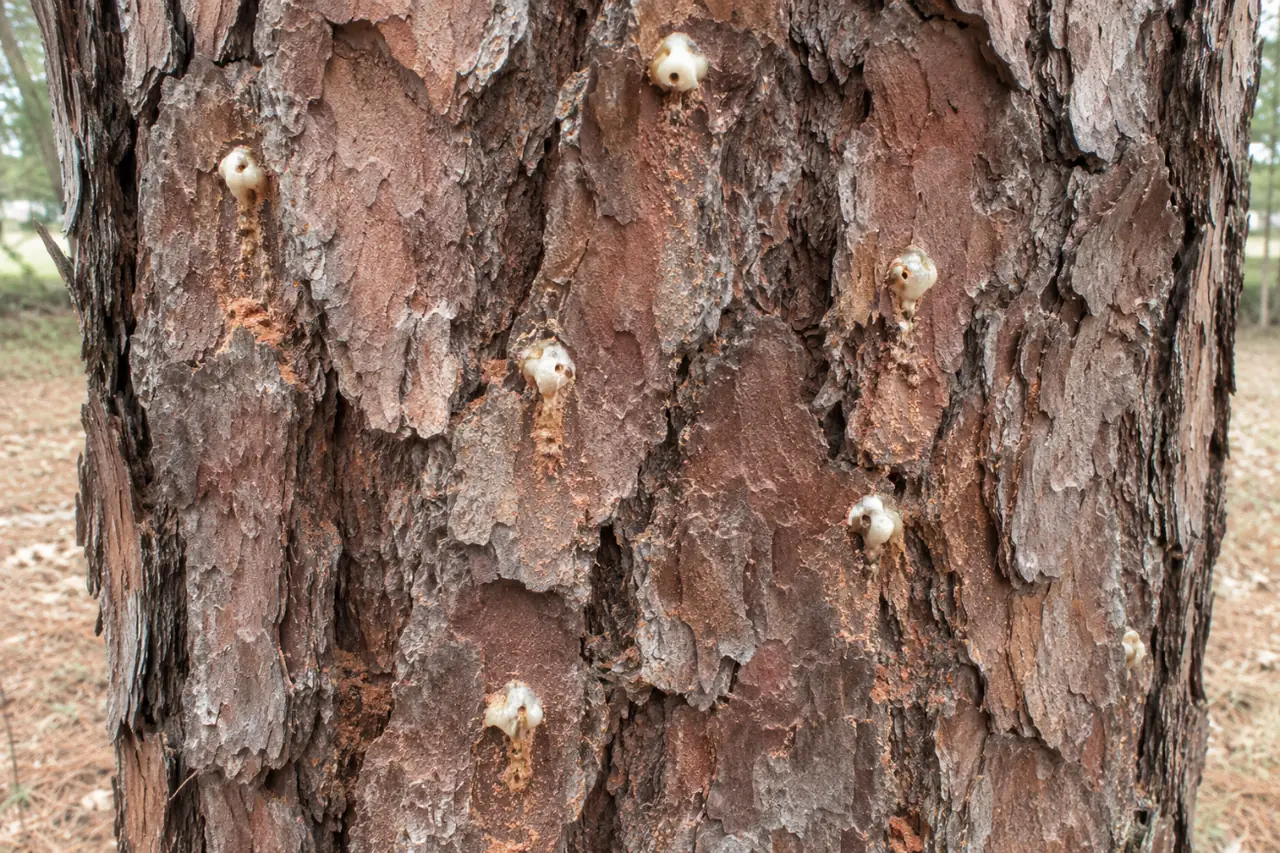
Which beetles are doing it?
FSA5034 names three kinds that attack Arkansas pines:
- Ips engraver beetles, three species, usually less severe; a few trees die each year, with attacks scattered rather than spreading in a spot.
- Southern pine beetle, the most destructive native species, which can move from tree to tree in less than a day during a severe outbreak. The U.S. Forest Service's 2025 forest health summary for Arkansas says outbreaks haven't been reported in Arkansas or states west of the Mississippi for over twenty years (Arkansas Forest Health Highlights 2025, checked Nov 21, 2026).
- Black turpentine beetle, the largest, which usually hits scattered trees low on the trunk and can kill over months or years, though trees often survive.
What should you do about a beetle-killed pine?
Take it down, and handle the wood carefully. For Ips, the U of A recommends doing the work in late fall or winter, when the beetles are less active, and not leaving infested tops and limbs next to healthy trees (FSA5034, checked Nov 21, 2026). In practice that means having the limbs chipped and the logs hauled, not stacked as firewood beside the pines you're keeping.
Spraying a tree that's already infested usually comes too late. The U of A Extension notes that sprays mainly serve to prevent attacks, not cure them, and need timed, repeated applications (U of A Extension, checked Nov 21, 2026).
Timing matters for a different reason too. A pine left standing dead for a long time can become unsafe to climb, which can push the job to a bucket truck or crane. HomeGuide's national range for removing a dead tree is $800 to $1,600 (HomeGuide, checked Nov 21, 2026).
What is the gray crust on a dying oak?
Most likely hypoxylon canker, a fungal disease. The U of A fact sheet FSA7557 describes it (FSA7557, checked Nov 21, 2026):
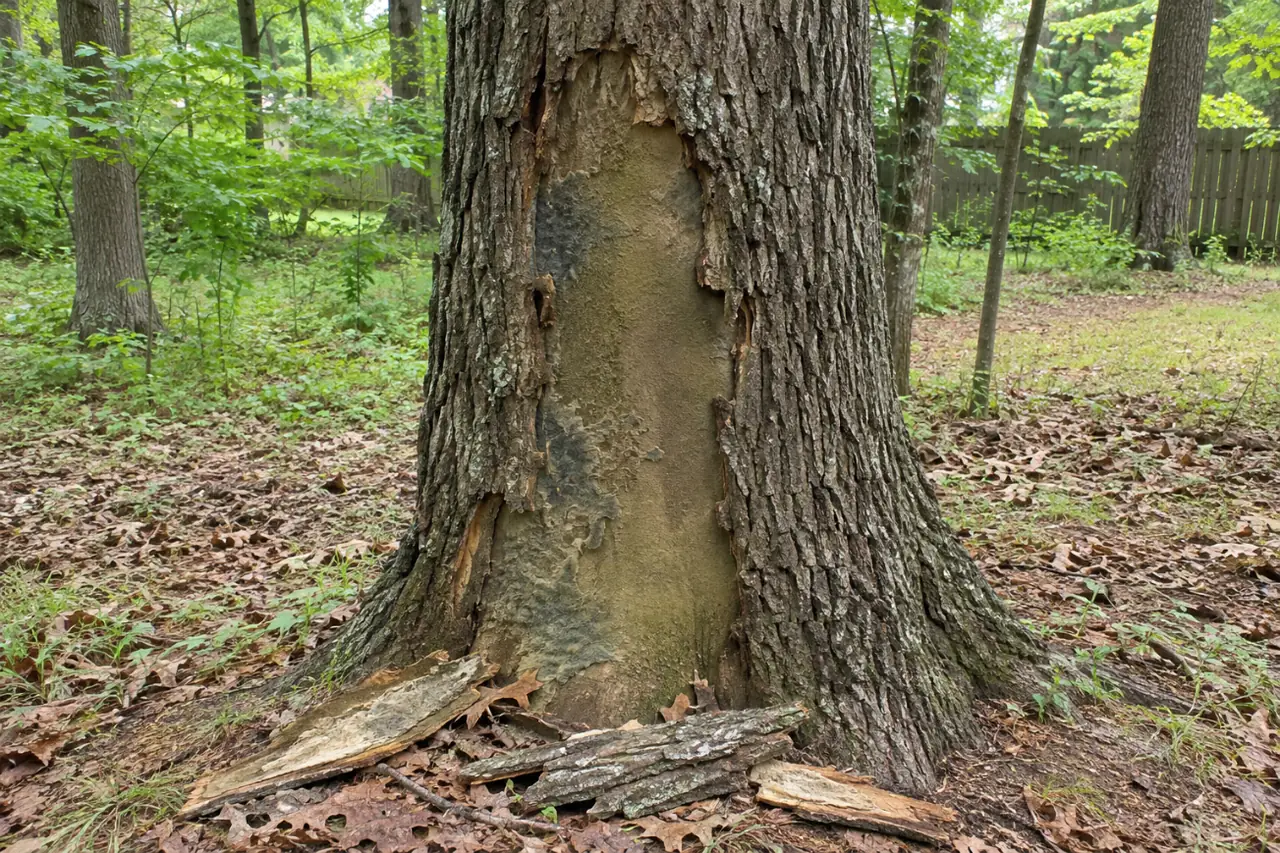
- Bark sloughs off the trunk or branches and reveals a "thin, powdery, greenish-brown to gray 'velvety' cushion" of fungus underneath.
- In spring and early summer the patches release clouds of spores when disturbed; by summer or fall they harden and turn bluish-gray to black, with a "charcoal" look.
- In humid weather, cankers can quickly grow to more than 3 feet long, and a canker that girdles a branch kills it.
- Oak is the most susceptible host; sycamore and elm can be affected too.
- Most damage is on stressed or injured trees; construction injury, herbicide damage and drought are listed contributors.
- There is no cure. Prevention and avoiding stress are the best defenses.
The fact sheet recommends removing the tree if its structural integrity is questionable, especially if it threatens structures or people, and having a trained professional evaluate tree health in urban areas. An oak with canker patches up the main trunk, over a house, is the case that matters most.
Why do drought years matter so much?
Because both problems above take advantage of stress, and dry spells stress every tree in the yard at once. Late summer 2026 was dry across Arkansas: on Aug. 20, 2026, the U of A reported most of the state still abnormally dry, all but six of its 75 counties under burn bans, and every county at moderate or high wildfire danger (U of A Division of Agriculture, checked Nov 21, 2026). Pines and oaks that came through that summer looking thin are worth watching closely next spring and summer, when beetles and canker show themselves.
Are ash trees at risk here?
They can be. Emerald ash borer, an insect that kills ash trees, has been confirmed in 44 of Arkansas's 75 counties, eight of them new in 2025 (Arkansas Forest Health Highlights 2025, checked Nov 21, 2026). That summary doesn't list the counties, so it doesn't say whether Lonoke or White County is one of them. If you have a large ash near the house that is thinning from the top, have it looked at.
When is a sick tree a removal job?
- A pine with a red or brown crown, or one that is fading and has fresh pitch tubes.
- An oak with canker patches on the main trunk or on big limbs over the house.
- Any tree with a dead top, large dead limbs over a roof or driveway, or bark falling off in sheets.
- A tree that lost roots to construction and has thinned out in the years since.
If it's close, a contractor can tell you which limbs or trees are urgent and which can wait for winter, when beetle work is better timed.
Dying tree questions
Can a pine with a few pitch tubes recover?
Sometimes. FSA5034 notes that healthy trees produce pitch that can repel small numbers of beetles. A tree that's pushing out resin and still has a full green crown is in a better spot than one with a fading crown and boring dust at the base.
Should the healthy pines next to a dead one come down too?
Not automatically. The beetle and how many trees are affected make the difference. Removing the dead one promptly and keeping its wood away from the others is the first step.
Will watering help during a drought?
Ask about your specific trees. FSA7557 lists irrigation among the ways to keep oaks vigorous, along with avoiding wounds.
Sources
- U of A Division of Agriculture: Pine Bark Beetles in Arkansas (FSA5034); FSA7557, Hypoxylon Canker; pine questions; burn ban article, Aug. 20, 2026.
- U.S. Forest Service, Arkansas Forest Health Highlights 2025; HomeGuide, tree removal cost.
- All checked Nov 21, 2026.
A tree on your mind in Cabot, Ward, Austin or Beebe?
Call the number or send the form. Your request goes to one independent contractor working in north Lonoke County and the Beebe side of White County, who comes out, sizes up the tree, names a price and does the job if you say go.