
Bradford Pear Tree Removal in Cabot, Arkansas
Bradford pear removal in Cabot means taking down a callery pear, the tree that covers itself in white blossoms each spring, before it splits apart, and then keeping the stump from sprouting back. The University of Arkansas calls Bradford pears invasive and warns that their weak branching gives way in strong storms (U of A Extension, checked Nov 21, 2026); call (501) 394-6165 and one independent contractor who works in Cabot, Ward, Austin and Beebe will look at your pear and price the removal.
Here's why they break, whether a healthy one has to go, how to stop the sprouts, and what to plant in its place.
Why do Bradford pears split?
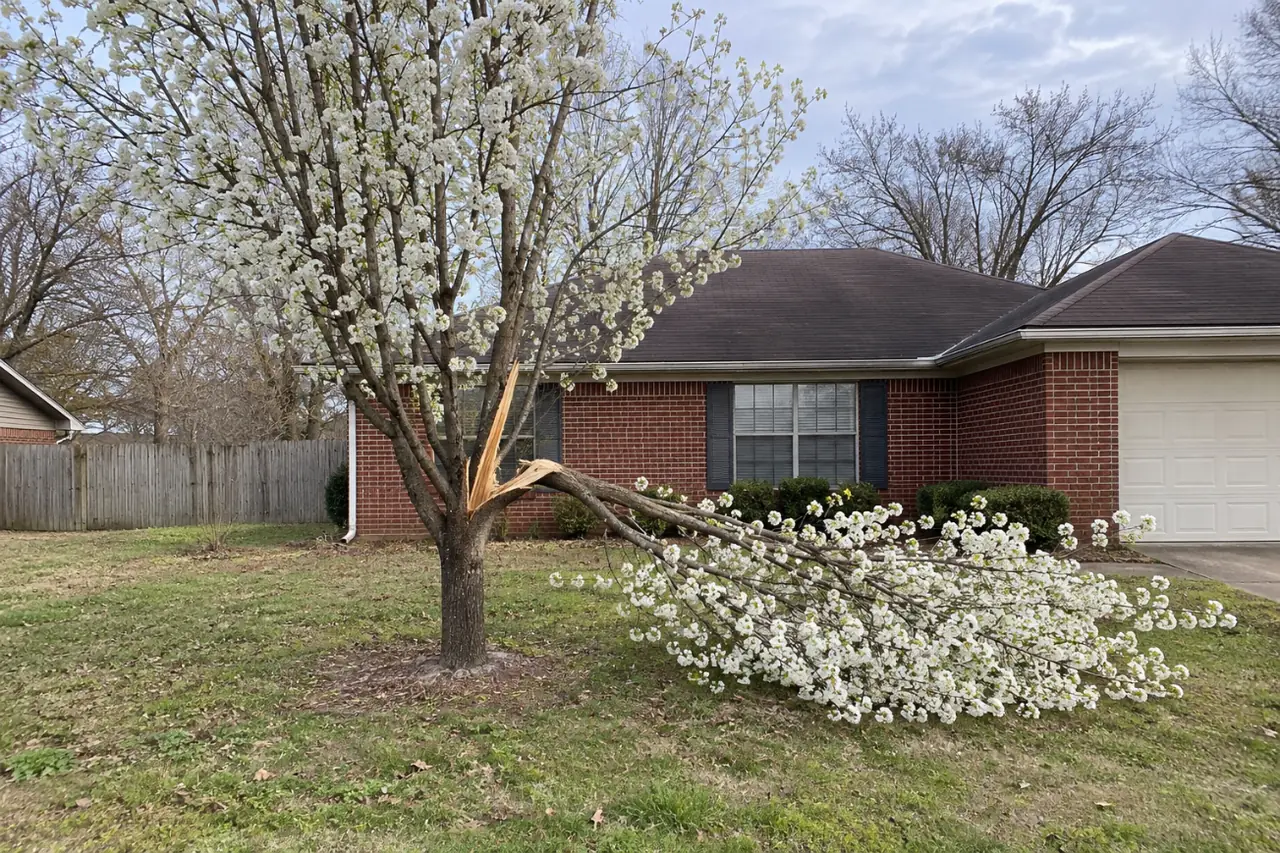
Look at a mature one from the street. Several big upright limbs rise from nearly the same spot on the trunk, packed together at narrow angles. As those limbs thicken, bark gets trapped in the tight forks between them instead of wood knitting them together. A load of ice or a strong gust pries one limb away from the others, and a big share of the tree can tear off, sometimes down to the trunk.
The U of A's White County Extension agent describes callery pears as "weak trees that are prone to wind and ice damage" and notes that the tree "is easily damaged by ice and wind, commonly resulting in utility outages" (U of A Extension, White County, checked Nov 21, 2026). The same office's pruning advice is to remove limbs that leave the trunk at angles under 30 degrees, because they may split as the tree grows (U of A Extension, White County, checked Nov 21, 2026). On an older pear, that can mean most of the tree.
Why does the U of A call them invasive?
The original Bradford trees were thought to be sterile, but the U of A explains that they cross-pollinate with other pear trees to create a wild hybrid, and those wild offspring can carry stiff thorns as long as 3 inches (U of A Extension, checked Nov 21, 2026). The White County office adds that birds spread the seeds, that the pears invade pastures, grasslands and open woodlands, and that they threaten native species; it recommends "zero tolerance" for callery pear (U of A Extension, White County, checked Nov 21, 2026).
Does a healthy Bradford pear have to come out?
Not by any rule. Cabot's development code doesn't require it, and the U of A's own invasive-plants page says removal "isn't necessary unless the tree is damaged or declining" (U of A Extension, checked Nov 21, 2026). It's a judgment call that comes down to what the tree would hit:
- A pear whose crown reaches the roof, the driveway, the service wire or the street is the one to deal with first.
- A pear that has already lost one limb has shown where it's weak, and its remaining limbs meet at the same kind of fork.
- A young pear in the open, far from anything, can wait, though it will only get harder and more expensive to remove as it grows.
How is a Bradford pear taken down?
A pear is usually a smaller job than a tall pine or a big oak: limbs cut and lowered or dropped into open lawn, the trunk felled or cut in pieces, everything fed through the chipper at the curb. Split or storm-damaged pears take more care, because a torn limb can still be under tension and shift when it's cut.
The important part comes after the trunk is down.
How do you keep the stump from sprouting?
Callery pear resprouts from the stump and roots. The White County office says mowing is ineffective because of resprouting, and gives the method: apply a 25% triclopyr ester solution or undiluted glyphosate to the entire cambium, the living ring just inside the bark, within 15 minutes of cutting. Follow-up treatments may be needed, and saplings can make seed as early as three years old (U of A Extension, White County, checked Nov 21, 2026). Always follow the product label.
Two ways to handle it:
- Treat, then grind later. The stump is treated right after the cut. Ask the contractor whether they'll treat it or whether you should be ready to.
- Grind deep. Grinding the stump and the main roots below grade, after an Arkansas 811 request, then pulling any sprouts that come up. See stump grinding.
What should you plant instead?
The White County article lists eastern redbud, American plum, Mexican plum and Carolina buckthorn as beautiful, noninvasive choices, and the U of A's invasive-plants page names serviceberry, dogwood and redbud, while advising against replacing a pear with another ornamental pear (White County; U of A Extension; both checked Nov 21, 2026). Under a power line, First Electric Cooperative's guidance is to avoid planting within 20 feet of the lines (First Electric, checked Nov 21, 2026).
What does Bradford pear removal cost?
Pears fall in the small and medium rows of the price tables. LawnStarter's Little Rock averages are $312 for a small tree and $864 for a medium one, with stump grinding averaging $288 (LawnStarter, checked Nov 21, 2026). HomeGuide's national range for trees under 30 feet is $150 to $500 (HomeGuide, checked Nov 21, 2026). Two or three pears on one visit usually cost less each than one at a time. The prices page has more.
Bradford pear questions
Can pruning save a split Bradford pear?
Rarely for long. Once a main limb has torn out, the remaining limbs share the same tight forks. Pruning can buy time on a young tree; on a mature, split one, removal is usually the better money.
Can I keep the wood?
Yes, if you ask. Say so before the job is priced, because leaving rounds stacked costs less than hauling everything away.
My neighbor's pear hangs over my driveway. What can I do?
Start with a conversation. Cutting a tree on someone else's land can be costly under Arkansas law; the permit page explains the property-line rule.
Sources
- U of A Extension, Bradford pear (Arkansas invasives).
- U of A Extension, White County, Think twice before planting: the invasive callery (Bradford) pear and pruning deciduous trees and shrubs.
- First Electric Cooperative, vegetation management; LawnStarter, Little Rock tree care; HomeGuide, tree removal cost.
- All checked Nov 21, 2026.
A tree on your mind in Cabot, Ward, Austin or Beebe?
Call the number or send the form. Your request goes to one independent contractor working in north Lonoke County and the Beebe side of White County, who comes out, sizes up the tree, names a price and does the job if you say go.